DAW Books – Vintage Sci-Fi Worth Collecting
My two-month sabbatical from writing allowed me to tackle my huge TBR pile. Many of these books are from one my favorite authors, whom I only discovered recently; CJ Cherry. I noticed one constant among her books, at least the ones I have: DAW published them all. Unless you’re colorblind, it’s pretty obvious with those highlighter-yellow spines and bright red author surnames emblazoned on them. I always wondered what the deal was with this weirdly specific format, and what other books they published. So I took some time to look into them, and I ended up with an even bigger TBR pile than I started with.
What is DAW?
Donald A. Wollheim co-founded DAW with his wife, Elsie, in 1972. The origin of the company’s name remains a closely guarded secret to this day. Donald Wollheim was already an accomplished editor at ACE, another legendary publishing house focused on science fiction. While there, he arguably popularized The Lord of the Rings, despite not being a fantasy fan, when he published the trilogy (against Tolkien’s wishes) in the United States. That’s a can of worms we don’t have time to get into today, which is a fancy way of saying I don’t know enough about the controversy to litigate it here.
He left ACE in 1971 after its owner died, by which point the company was in financial ruin. Wollheim founded DAW with the help of Elsie that year, and published their first book in 1972, Spell of the Witch World by Andre Norton. They’d mostly stick to science fiction at first, though they eventually branched out into fantasy and horror. Donald headed the company until his death in 1990 when Elsie took over until she passed it on to their daughter, Betsy, in 1995.

Scandalously Clad Spines
The most distinctive feature of early DAW books are their yellow spines, with the author’s name written in red and the title in black. They were also ahead of their time, printing publication numbers on the side, something modern day collectors drool over. They spared no expense when it came to covers either, hiring renounced painters like Jack Gaughan, Josh Kirby, Kelly Freas, and Michael Whelan. Okay, a lot of these covers feature plenty of T&A (Freas in particular was a big fan), but I read them for the articles. This format—the glorious yellow spines and incredible cover art—ended after publication #580 in 1984 (The Book of Ptath), but you can at least still find the publication numbers either on the front cover or on the first page. But it was the yellow-spined novels that are seen as the golden age for collectors. Or perhaps the yellow age.
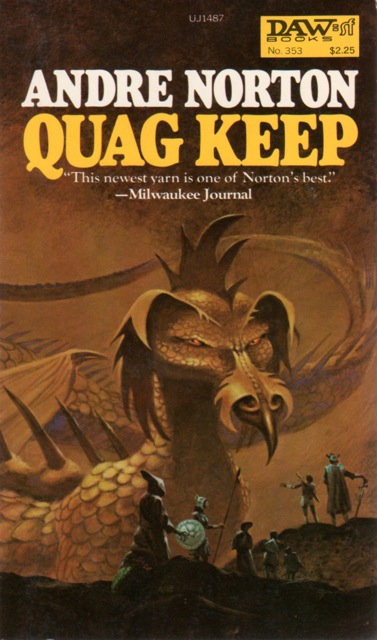
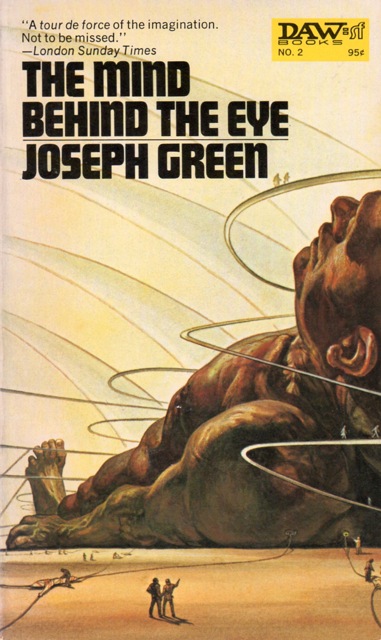
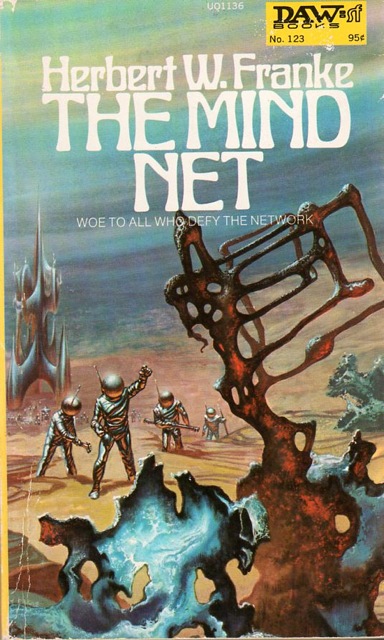
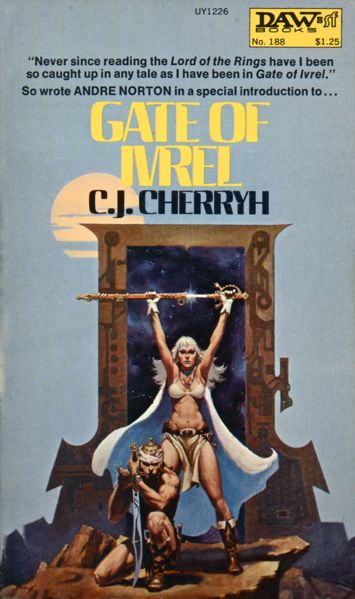
‘The faded age’ might be a better name, though. These yellow-spined books are infamous for the yellow printing fading over time from UV light exposure. The red lettering of the author’s surname also fades into a pinky-nothingness. My DAW collection is less a sea of yellow and more of a gradient from yellow to white, some even brown. DAW was a budget publisher, with books never costing more than about $4 from this era. They used the cheapest materials they could get their hands on, as not only did the spines easily fade, but the pages themselves yellow with age. There’s no information about the author, either. These books also sometimes featured ads directly bound inside them. Often they were cards advertising other DAW books, but some of their earlier releases featured ads for other products, including, of course, cigarettes.

It’s not simply about lemon-colored edges and boobs, you hastily tell your significant other as you hide your copy of The Jaws That Bite, the Claws That Catch, it’s also the content. Every DAW book is special, even the “lesser” ones. Their list of published authors from this time includes titans like CJ Cherryh, Andre Norton, Philip K. Dick, Fritz Leiber, Frederik Pohl, A. E. van Vogt, Dean Kootz, and about a dozen others you’d be justified in yelling at me at for not including. They also published Marion Zimmer Bradley and L. Ron Hubbard, but whom among us hasn’t… you know what? Let’s not finish that sentence.
Betsy Wollheim still heads DAW today, and they’re arguably better than ever with multiple Hugo and Nebula winning and nominated works in the last decade. They “discovered” Nnedi Okorafor, publishing her first novel Who Fears Death in 2010, which was nominated for a Nebula and won multiple other awards. They continue to publisher her novels, as well as the works of Patrick Rothfus, Suzanne Palmer, Beth Revis, and still after all these years, CJ Cherryh. They’ve lost their “underground cool” card though, as Astra Publishing House bought DAW in 2022. Astra is still a new company, only founded in 2020, so it was a shocking move. So far it’s worked out, but we’ll only know if the move paid off if they publish my novel at some unknown point in the future.
Collecting, or How I Found a New Obsession
DAW books are considered something of a collector’s item in certain circles. The historical significance of both Donald Wollheim and the authors he published, the distinct yellow spines, the incredible covers, and the collector's number featured prominently on the cover all make these books super collectible. To a small handful of people, anyway. DAW books are readily available on eBay and most used book stores, and don’t usually go for more than $5 to $8 a pop.
I wish I had a compelling story about how a long lost friend donated their DAW collection to me on their death bed, or that I entered a contest and won some graybeard’s hallowed library of old science fiction. It’s just a case of looking into their history, look at some of their books, and liking what I saw.
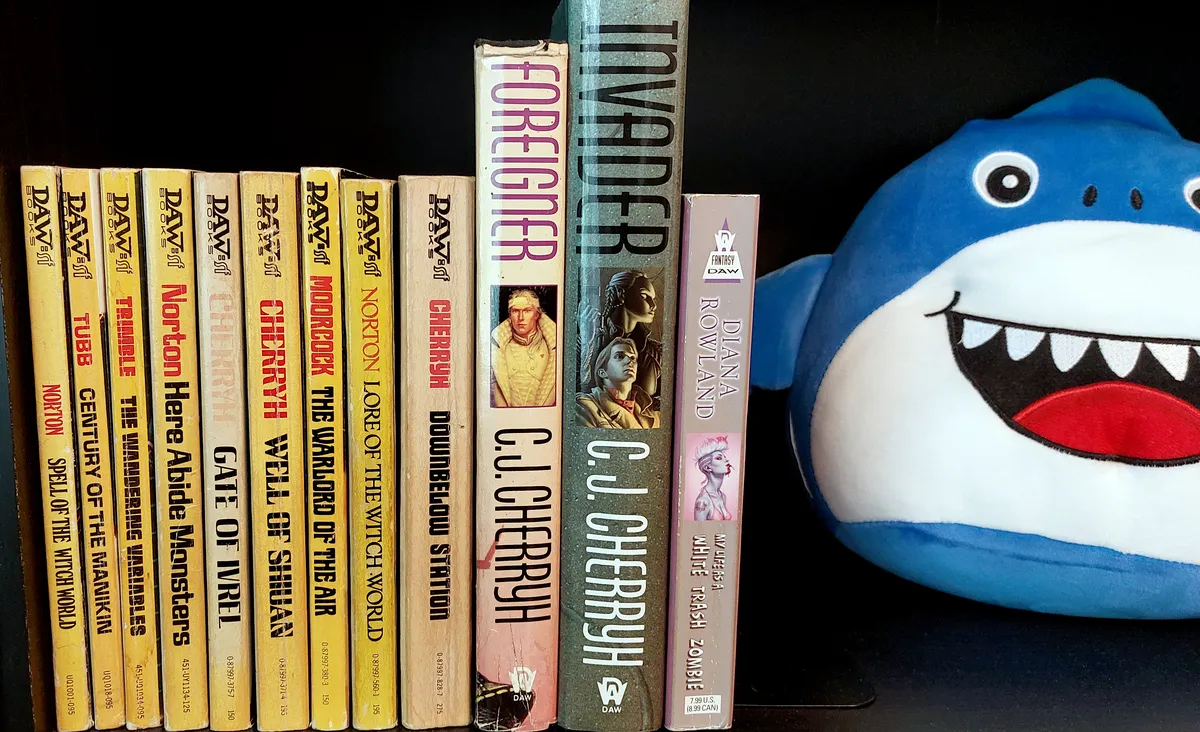
Despite that history, I was surprised at how cheap DAW books typically are. I browsed eBay for a few nights until I found a particularly great deal on a lot of 20 DAW yellow-spines in good condition and grabbed it. That same night I found another great deal on 10 Andre Norton books, whom I heard was a great sci-fi and fantasy writer, so I grabbed that two. Now I had 30 yellow-spine DAW books for less than $30, all in good shape. I stopped there and read all those books before considering spending any more money on them. Yeah right, nobody’s buying that.
I read two of these books before deciding to continue with my newfound hobby. They were Here Abide Monsters by Andre Norton and Century of the Manikin by EC Tubb, both flawed books in their own way but fascinating reads. I could write a whole blog about these two alone and their contrasting styles, and Tubb’s seeming hatred of women, but I’ll save that for another day. They are so unlike anything I’ve read lately, sci-fi or otherwise, that they intrigued me. Here are books that explore what the future could look like, through the lens of the 1970s. The technology and societal changes presented in these books are quaint by today’s standards (a wristwatch that can communicate to people over long distances! A man dressed as a woman out in the open!), but that’s what makes them so compelling. Many of them offer either an idolized version of the world that never happen, or a stark warning that went unheeded.
It's like time travel in a way, reading the words written by a long-dead person 50 years ago in a time that to them was the far future. It makes you wonder what someone reading sci-fi in 2076 will think about what’s being written today. What books will stand the test of time like Dune, and what will fade into a curiosity for hardcore collectors, like Century of the Manikin?
In the age of AI slop (and AI companies buying up millions of books just to scan and pulp them), that we forget about these artistic books created by humans full of ideas and hopes and dreams and fears for the future. No, many of these aren’t the best, a lot of them are outright bad, but there are real gems here. Even the bad ones will always be better than whatever trash AI spits out for that reason alone. I love knowing that I can pick up any of these books (at least the published before 2020) and know that a human artist crafted what I’m reading, untainted by ChatGPT or Claude or whatever other world-burning mass-plagiarism machine that have ruined the modern world. I don’t have to worry about any of these authors releasing AI-generated images of their wife as a caveman, for instance. That alone is worth the low price of admission.
With that in mind, I bought… well, a few more. Including another deal on some newer DAWs published in the 90s. My next blog will be a review of one of these books, from the prolific author Zach Hughes, so stay tuned for that.
Can’t Stop, Shan’t Stop
I’m not trying to collect every book DAW ever published. I’m cheap (and broke) above all else, and even though most DAWs are inexpensive, I won’t buy something I don’t want for the sake of owning it.
In June, whenever I had a moment, I’d go through ISFDB’s list of every book published by DAW, from their first in April 1972 up through February 2026 when this chart was last updated. That’s 1,981 books to look through. This took a minute. Several minutes, in fact. I didn’t go heavy into research, I just checked out the cover, the author, and a blurb for each book and decided if that sound like my cup of orange juice. I think the kids would call it a “vibe check,” but they’re all too busy playing Roblox for me to ask.
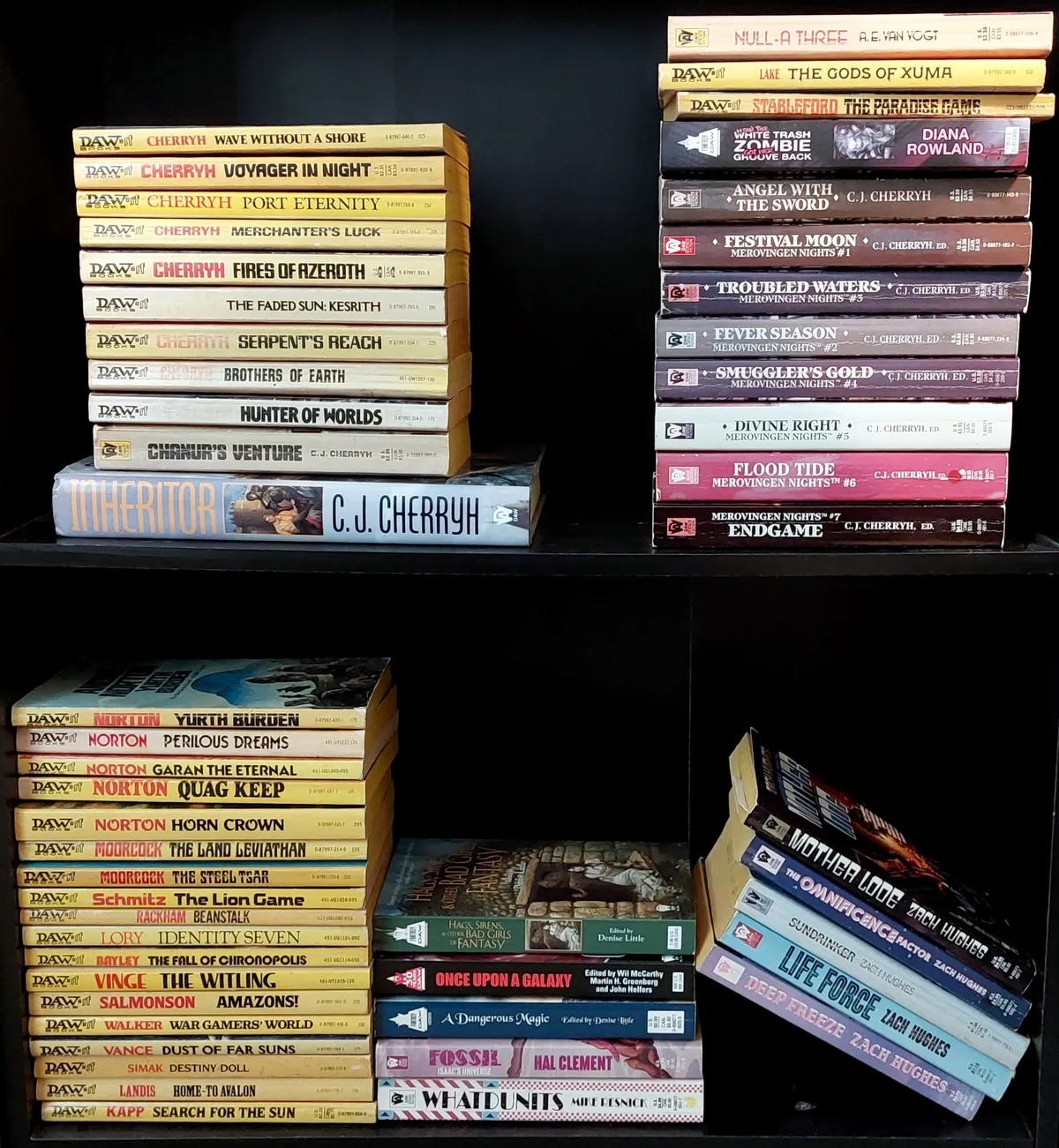
I learned a lot about historic science fiction, and publishing practices from back then. I learned about Andre Norton and Ron Goulart. I discovered Philip K. Dick’s less mainstream works like Now Wait for Last Year and A Maze of Death. Did you know John Jakes wrote a bunch of science fiction? Being a southerner, I only ever knew him as the guy who wrote confederacy apologia. I started reading more short stories, thanks not only to the Annual World’s Best SF but also Isaac Asimov’s The Great SF Stories series, the more recent Once Upon a Galaxy, and Cherryh’s own Merovingen Nights books.
In the following weeks and months, when I realized that DAW books are so cheap and readily available, I started buying lots on eBay almost at random, ignoring the list I spent so much time on. I now have a stack of 49 DAW books to read, ranging from as recent as #39, The Lion Game by James H. Schmitz, to #1657, How the White Trash Zombie Got Her Groove Back by Diana Rowland. When I say I collect DAWs, I mean I collect DAWs, new and old. I’m growing increasingly hesitant to pick up modern books, but I do want to pick up Nnedi Okorafor’s Binti trilogy and Noor. I wanted to pick up some of Adam Oyebanji and Wole Talabi’s books too, but then I found that Talabi is an AI apologist and Oyebanji admitted to using AI. After cleaning up the glass from smashing my head through a nearby window, I scratched them from the list.
A Worthwhile Hobby?
What I didn’t expect from this was how fun the simply collecting these books is. Everything from researching the books, to finding deals on eBay, to opening the packages, cleaning the books and cataloging them, and deciding what I’m going to read next has been a blast. It’s been over a month since I’ve read a non-DAW book now, and I don’t see that streak ending anytime soon. I’d say this must be what those people who collect Pokemon cards feel like, but let’s be real, 99% of those people are looking to resell. DAWs have about as much resale value as eaten food, so I won’t be making a fortune on these anytime soon.
Would I recommend you collecting these books? I don’t know, if you want to, go for it. You can’t go wrong with 1970s and 1980s era CJ Cherryh. Andre Norton has written a lot of good books, Spell of the Witch World is a good starting point for her. Check out Nnedi Okorafor or Christoper Ruocchio if you’re looking for something more modern. They’ve also published plenty of fantasy and horror, if that’s what butters your orange juice. They’ve republished so many books over the years you might have already read a DAW book without even realizing it.
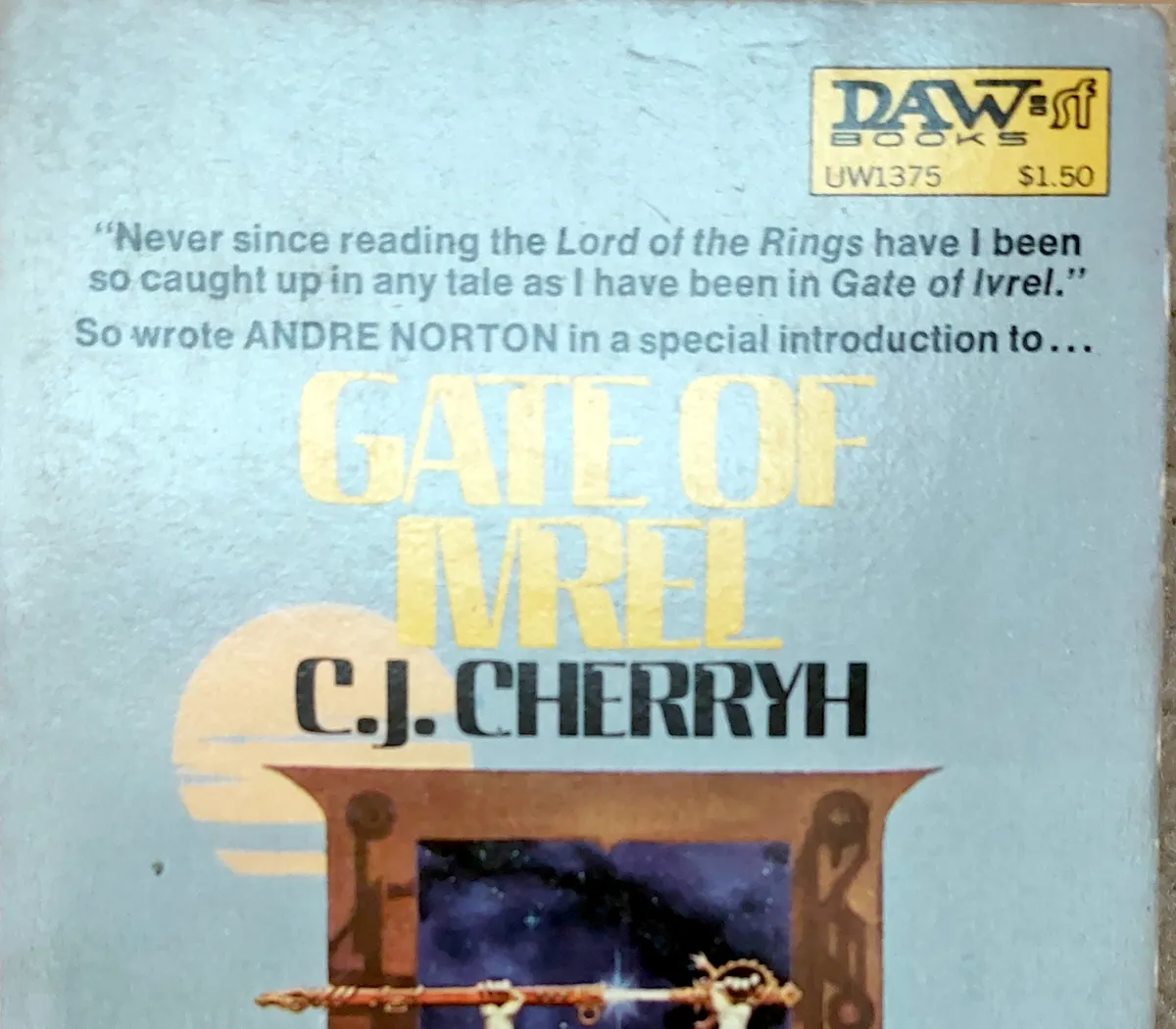
Here’s another tip. If you look at the top right corner of an early DAW book, you’ll see the company’s logo in a yellow box. Also inside this box are the price of the book and a number. That number is the collector number, and this is a good indicator of what printing the book is. If it is a number from 1 to 580, it’ll be much more collectible than if the number begins with UE or UW, followed by four digits. These books are reprints, made years after the original printing and are less collectible. If you even care about that sort of thing. Even these first printings aren’t rare or valuable, but they’re worth a little more than the reprints. That being said, lots featuring Michael Moorcock, or anything by Philip K. Dick can go for upwards of $100 or more online, so there are some expensive ones if you want to go after the famous authors.
Thing of the Whenever
While researching DAWs, I stumbled across Joachim Boaz’s long-running site Science Fiction Ruminations, which is a wonderful treasure trove of reviews and, well, ruminations, on old school sci-fi. The first article I read was a review of Richard Wilson’s short story Strike. Fitting, considering one of my first blogs was a look at Richard Wilson’s career and one of his last stories, The Story Writer. Boaz’s review is much better written and researched than my slap-dashed post though, and I highly recommend it.
Speaking of obscure old books, I also discovered Brad Bigelow’s Neglected Books. Not science fiction focused, but still an excellent resource for obscure old books. As the name suggests, the website is about cheese. Wensleydal, parmesano reggiano, even cottage cheese and cream cheese make cameos. But sometimes he writes about obscure old books, too. The latest (at the time of writing this) is a look at the career of Herbert Clyde Lewis, who has gained renowned recently with his 1936 novel Gentlemen Abroad, but was overlooked in his own time. ‘Who Owned This Book?’ is a fun detective story about Bigelow trying to track down a woman who signed her name in a book he bought, and it turns out she was a prolific writer herself with an interesting story. There’s also an excellent deep dive into Gale Wilhelm, one of the first women to write about lesbian relationships, and the mystery of why she stopped writing in the prime of her career.
The internet isn’t dead quite yet.
Please, consider supporting me on Ko-Fi